Train Callouts
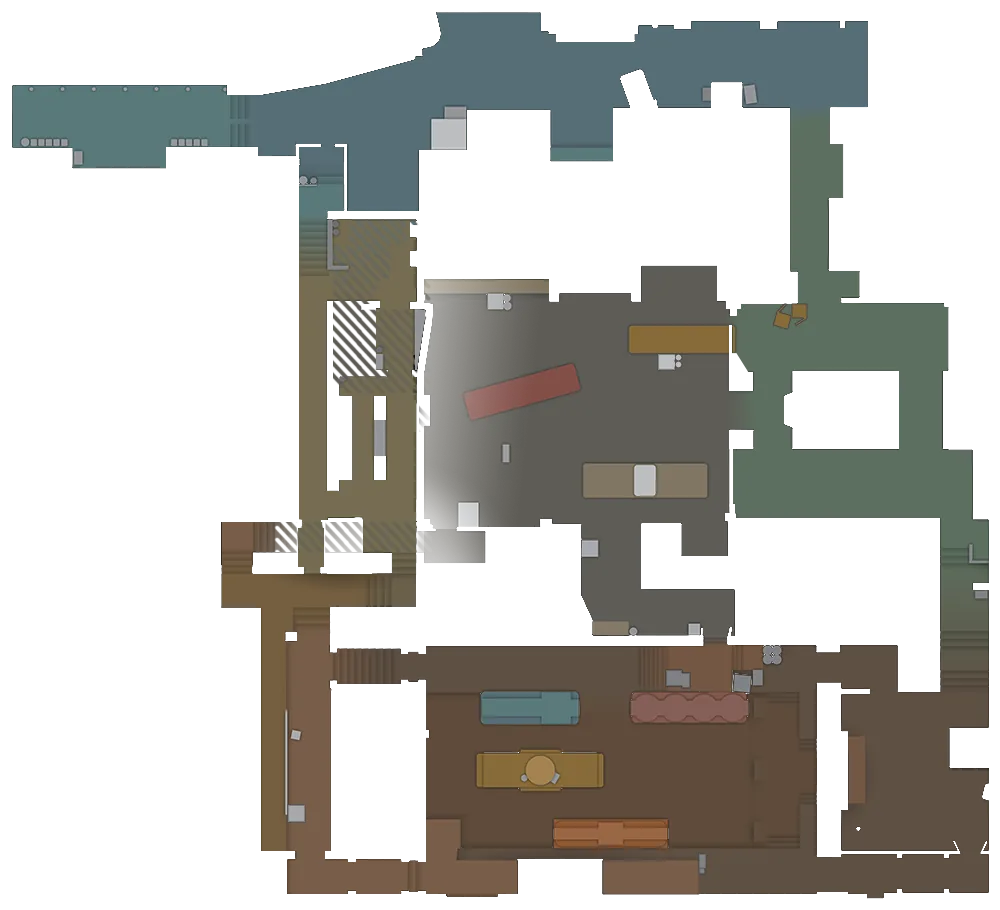
Hover or tap a callout, or anywhere inside an area, to see exactly where the game draws its edges.
How to use it
- Hover a callout name, or anywhere on the Train radar, to see the area it covers.
- Type in the search box to find a callout, including community names like the ones your team uses.
- Zoom in (2x, 3x) on a phone to read the tight areas, then tap a callout and copy its link to send it to your team.
Every Train callout (16)
The in-game name is the one the game uses internally and in demos; a player's position in demo tools and stats sites uses it too.
| Callout | In-game name | Community names in it |
|---|---|---|
| Alley | Alley | Pigeons |
| Back of B | BackofB | - |
| Bombsite A | BombsiteA | Olof, Hell, Sandwich |
| Bombsite B | BombsiteB | B Halls, Upper B, Headshot, Oil |
| Connector | Connector | - |
| CT Start | CTSpawn | Old Bomb |
| Dumpster | Dumpster | - |
| Electrical Box | ElectricalBox | - |
| Entrance | Entrance | - |
| Ivy | Ivy | Pigeons, Old Bomb |
| Longdog | LongDog | - |
| T Main | TMain | Showers |
| T Side Upper | TSideUpper | B Halls |
| T Stairs | TStairs | Brown Halls, Kitchen |
| T Start | TSpawn | - |
| Tunnels | Tunnels | - |
Train community callouts
Names players use for spots the game doesn't name. No game file says where they are, so we don't pin them on the map: each one is listed with the in-game area it sits in. We kept only names that at least two independent callout guides agree on.
- Olof (Bombsite A)A raised box spot against the A wall facing the T entrance.
- Hell (Bombsite A)The cubby beside a train on A with an angle to Ivy.
- Sandwich (Bombsite A)The gap between two trains at the top of A.
- Pigeons (Alley / Ivy)The choke Ts hold before pushing into Ivy.
- Old Bomb (CT Start / Ivy)The alley with a train near CT spawn.
- Showers (T Main)The corridor above A Main running beside Brown Halls.
- Brown Halls (T Stairs)The tight hallway Ts use toward the B side.
- Kitchen (T Stairs)The small room beside T Stairs used to watch for rushes.
- B Halls (T Side Upper / Bombsite B)The main T corridor feeding Upper B and B Ramp.
- Upper B (Bombsite B)The raised entrance overlooking the B trains.
- Headshot (Bombsite B)The raised corner at the end of Catwalk, under the ladder.
- Oil (Bombsite B)The dark oil train on B next to Catwalk.
How this map is made
Most callout maps are drawn by hand on a screenshot, so labels drift and areas are guesses. This one is read from the game: every named area in Train is a volume in the map file with a place name, and the game shows that name under your radar when you stand in it. We took each volume's outline from the map, projected it onto the official radar image with the game's own radar coordinates, and put the label at the centre of the area. The English names are the game's own translations.
Some callout maps place each label at a single reference point of the volume, which can put a name like CT spawn a long way from the area it names. Here the label always sits inside its area, and you can see the whole area by hovering it.
Learning the map? Set up your crosshair and viewmodel like the pros, open a free CS2 case every day, or compare CS2 trading sites for your next skin.
Callouts for other maps
Sources: CS2 game files, build 1.41.9.1 (Oct 15 2026): the map's place volumes, the radar image and coordinates (resource/overviews/de_train.txt) and the English place names. Map pool status from Valve's CS2 update notes. Community callouts: checked against at least two independent callout guides each (16 October 2026).
FAQ
- How many callouts are there on Train?
- The game itself names 16 areas on Train: these are the names the game shows under your radar. Players also use community names for smaller spots, such as Olof, Hell, Sandwich.
- Where do these Train callouts come from?
- From CS2's own map file. Each callout is a volume in the map (an env_cs_place entity) with a name the game shows on the radar when you stand in it. We read every volume and its outline from the Oct 15 2026 build (1.41.9.1) and drew it over the game's radar image, so the labels sit where the game puts them.
- What is the difference between in-game and community callouts?
- In-game callouts are fixed by the map: the game shows them on the radar and records them in demos (for example Alley, Back of B, Bombsite A). Community callouts are names players invented for smaller spots, like a box or a window, and can differ between teams and regions.
- Is Train in the CS2 Active Duty map pool?
- Not right now. Valve took it out on 21 January 2026. You can still play it in Competitive and Casual, and the callouts haven't changed.
More free tools
- Crosshair generator & codesBuild a crosshair with a live preview, or copy a pro's share code.
- Viewmodel generatorPreview viewmodel settings and copy the console commands.
- Config & launch optionsBuild an autoexec, binds and launch options, ready to paste.
- Sensitivity converterConvert your sens between CS2, Valorant, Apex, Fortnite, Overwatch 2, Rust and more.