CS2 Premier Ranks: CS Rating Colours, Seasons and All 18 Skill Groups
CS2 Premier ranks are seven colours set by your CS Rating, one every 5,000 points. Here are the colours, every Premier season so far, how your rating moves, leaderboards and the 18 Competitive skill groups, from Valve's own notes.
Updated
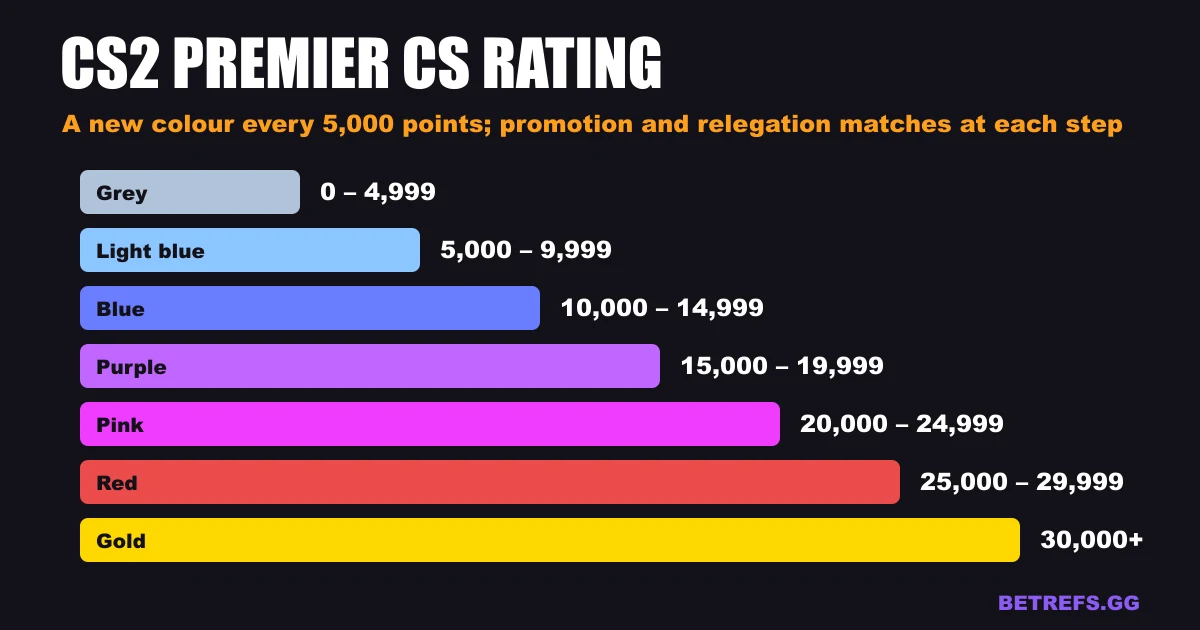
CS2 Premier ranks are seven colours, from grey to gold, set by your CS Rating: the colour changes every 5,000 points. That's one of CS2's two ranking systems. Premier gives you one number, your CS Rating, for all maps. Competitive gives you one of 18 classic skill groups, from Silver I to Global Elite, separately for every map. Here's how both work, from Valve's own release notes and support pages.
Premier ranks by CS Rating
Premier is CS2's main ranked mode, played on the Active Duty maps. Valve calls the CS Rating "a visible measurement of your Counter-Strike performance". It's one number for all maps, it decides where you stand on the leaderboards, and its colour is your Premier rank:
| CS Rating | Colour |
|---|---|
| 0 to 4,999 | Grey |
| 5,000 to 9,999 | Light blue |
| 10,000 to 14,999 | Blue |
| 15,000 to 19,999 | Purple |
| 20,000 to 24,999 | Pink |
| 25,000 to 29,999 | Red |
| 30,000 and up | Gold |
Promotion and relegation. Since October 2023, promotion and relegation matches only happen at those colour boundaries, every 5,000 points. So you play a promotion match to move up a colour, and a relegation match before you drop one.
Gold, from 30,000, is the highest colour. Valve hasn't published a maximum rating.
How your CS Rating goes up and down
You gain rating for a win and lose it for a loss. Valve doesn't publish the formula, but its release notes say a fair amount about how it behaves:
- Wins to show a rating. At the start of Season Two, Valve recalibrated every player's rating from their Season One results, and everyone had to win 10 matches to show it again. Valve hasn't published the number for new accounts.
- Bigger swings after calibration. In October 2023 Valve increased how much rating a win or loss can move, "to move players faster after calibration". The same update made matchmaking pick teams with smaller rating differences, at the cost of longer queues.
- Kicked or abandoned matches. If you're kicked, your rating follows the final result of the match. Since November 2023 CS2 shows a notice when your rating was adjusted after a match, for example for a match you were kicked from or abandoned, or when you get back points lost to a cheater.
- Inactivity. If you stop playing Premier for a while, you have to re-establish your rating. Valve adjusted how that works in November 2023 but doesn't say how long the break has to be.
- Cheating bans hit the party. When a party member is convicted of cheating and permanently banned, Valve says "all their associates" lose CS Rating and Profile Rank (your XP level) too. It doesn't define who counts as an associate.
- Who you can party with. Players with a very high established rating can't queue with accounts that don't have a rating yet, and there's a limit on how far apart party members' ratings can be. Valve adjusted that range in February 2024 and again in February 2025, without giving the numbers. Parties of four have been able to queue for Premier since November 2023.
How Premier picks the map
Since 22 September 2026 there's no ban phase in Premier. Per the release notes, team 1 picks one map, team 2 picks two, team 1 picks a fourth, and then one of the four is chosen at random. (Valve's blog post for the same update says each team picks two.) Valve's reason: players who spend time learning a map should get more chances to play it. Before that, teams banned maps down to one.
Premier seasons
Premier runs in seasons, and Seasons Two to Five each started with a change to the map pool. These are all the seasons so far, with dates from Valve's release notes:
| Season | Started | Ended | Active Duty change |
|---|---|---|---|
| Season One | 27 September 2023 (CS2 launch) | 28 January 2025 | Dust II in, Overpass out (25 April 2024, mid-season) |
| Season Two | 28 January 2025 | 14 July 2025 | Train in, Vertigo out |
| Season Three | 16 July 2025 | When Season Four began | Overpass in, Anubis out |
| Season Four | 21 January 2026 | When Season Five began | Anubis in, Train out |
| Season Five | 8 July 2026 | Not announced | Cache in, Overpass out |
Valve's full notes for each of these updates are on our CS2 updates page.
The current season is Season Five, which started on 8 July 2026. Valve hasn't announced when it ends. For Season Two, Valve announced the end ahead of time: it ran until the Austin Major and ended on 14 July 2025.
Season medals. Every player who earned a CS Rating in Season One got a Premier Season One Medal, with graphs of their season. From Season Two to Season Four, Valve set the same rules: the medal's colour matches the highest CS Rating you reached that season, and it has one bar for every 25 wins, up to five. To get one you need an account in good standing, 25 Premier wins in the season and a visible rating when it ends. Valve's Season Five notes don't mention a medal.
Leaderboards
There are nine: Friends, World (the top 1,000 players) and seven regions: Africa, Asia, Australia, China, Europe, North America and South America. You need Prime status (CS2's paid upgrade), and you show up on a public leaderboard once you're in the top 1,000 of your region. You can't pick your region: it's set by the servers you play on most.
They aren't always filled when a season starts. In Season Two, Valve announced the world and regional leaderboards were populated on 13 May 2025, more than three months in.
Is there an official Premier rank distribution?
No. Valve shows the top 1,000 players per leaderboard in the game, but it doesn't publish how many players hold each colour or what percentile a rating is. The colour bands are fixed at 5,000 points each; they say nothing about the share of players in them. Valve's leaderboard method in the Steam Web API (ICSGOServers_730/GetLeaderboardEntries) no longer answers at all: when we checked on 24 October 2026, every request got "410 Gone".
So any Premier rank distribution chart you find online was built by a third party from the matches it collects, not by Valve. We don't publish one here because we can't source it to Valve.
Competitive: the 18 skill groups
Competitive mode keeps the skill groups CS:GO players know, but each map has its own. You can be Gold Nova on Nuke and Master Guardian on Mirage. A map shows its skill group once you've won enough matches on it.
| # | Skill group |
|---|---|
| 1 | Silver I |
| 2 | Silver II |
| 3 | Silver III |
| 4 | Silver IV |
| 5 | Silver Elite |
| 6 | Silver Elite Master |
| 7 | Gold Nova I |
| 8 | Gold Nova II |
| 9 | Gold Nova III |
| 10 | Gold Nova Master |
| 11 | Master Guardian I |
| 12 | Master Guardian II |
| 13 | Master Guardian Elite |
| 14 | Distinguished Master Guardian |
| 15 | Legendary Eagle |
| 16 | Legendary Eagle Master |
| 17 | Supreme Master First Class |
| 18 | Global Elite |
In January 2026 Valve adjusted the hidden rank values behind these skill groups and expired everyone's existing per-map skill groups. They come back once you win enough matches on that map again. Wingman has its own skill groups with the same 18 names.
Premier or Competitive?
- Premier if you want one number that follows you across maps, a spot on the leaderboards and a colour to show off. Matches start with each team picking maps, then one is drawn at random.
- Competitive if you want to play one map you choose, or learn a new one without risking your rating.
Both play up to 24 rounds in regulation time, with overtime on a tie.
Who you get matched with also depends on Trust Factor, a score CS2 keeps hidden. Valve says your CS2 rank is one of the things it counts: see our Trust Factor guide.
Is there an official CS Rating to skill group chart?
No. Valve doesn't publish one, and the two systems measure different things: one rating across all maps against one skill group per map. Charts you see online that say "15,000 equals Legendary Eagle" are players' estimates, not Valve's numbers.
Get the setup right first
Rank is mostly practice, but settings help. Copy a pro's crosshair from our CS2 crosshair codes page, and find the commands for practice servers on our console commands list.
Sources
- Counter-Strike 2: Your Time is Now (CS Rating and Premier) · Valve
- Counter-Strike 2 release notes, 10 October 2023 (promotion and relegation at colour boundaries) · Valve, October 10, 2023
- Counter-Strike 2 update, 21 January 2026 (Premier Season Four, per-map skill groups expired) · Valve, January 21, 2026
- Counter-Strike 2 Leaderboards FAQ · Steam Support
- Release notes for 27 September 2023 (Season One, CS Rating penalties, party limits) · Valve, September 27, 2023
- Release notes for 6 October 2023 (kicked players) · Valve, October 6, 2023
- Release notes for 3 November 2023 (mid-match rating adjustments) · Valve, November 3, 2023
- Release notes for 8 November 2023 (inactivity, parties of four) · Valve, November 8, 2023
- Seasons Change (end of Season One, recalibration, medals) · Valve, January 25, 2025
- Release notes for 25 April 2024 (Dust II replaces Overpass) · Valve, April 25, 2024
- Counter-Strike 2 update, 28 January 2025 (Premier Season One is over) · Valve, January 28, 2025
- Counter-Strike 2 update, 28 January 2025 (Premier Season Two) · Valve, January 28, 2025
- Counter-Strike 2 update, 13 May 2025 (Season Two leaderboards populated) · Valve, May 13, 2025
- BLAST.tv Austin Major Champions (Season Two ends 14 July) · Valve, July 2, 2025
- Season Two: Episode One (Premier Season Three, medal rules) · Valve, July 16, 2025
- Counter-Strike 2 update, 8 July 2026 (Premier Season Five, Cache added) · Valve, July 8, 2026
- Release notes for 6 February 2024 (party rating range) · Valve, February 6, 2024
- Counter-Strike 2 update, 6 February 2025 (party rating range) · Valve, February 6, 2025
- Rush Hour (why Premier map selection changed) · Valve, September 22, 2026
- Counter-Strike 2 update, 22 September 2026 (new Premier map selection) · Valve, September 22, 2026